Red imported fire ants (Solenopsis invicta) establish extensive subterranean networks across North Carolina's coastal plains and Piedmont borders. In Nashville, sandy-loam soils near Stony Creek Reservoir and clay turf…
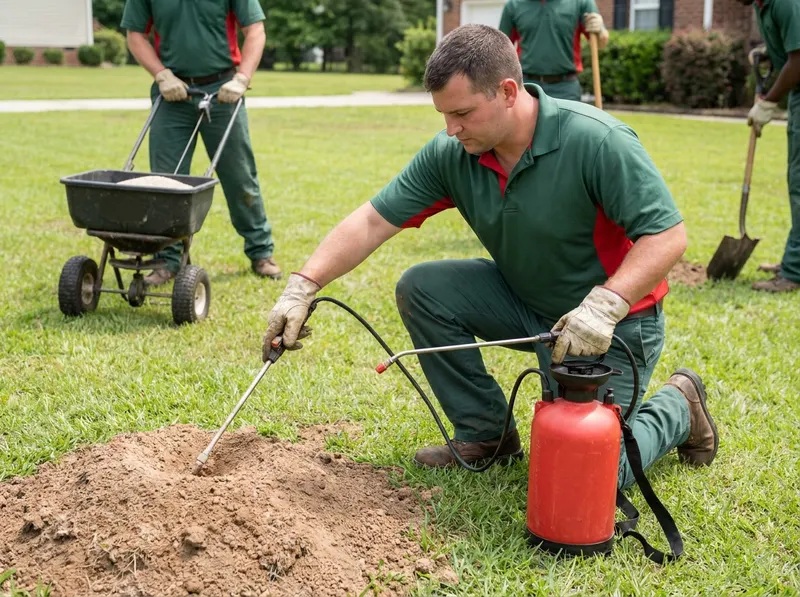
Red imported fire ants (Solenopsis invicta) establish extensive subterranean networks across North Carolina's coastal plains and Piedmont borders. In Nashville, sandy-loam soils near Stony Creek Reservoir and clay turf profiles around Birchwood and Westwood provide conditions where a single acre can harbor 30 to 100 distinct mounds. Surface spraying with retail contact insecticides kills visible foragers but triggers mound fission, where the colony fragments into multiple smaller satellite nests across the lawn. Professional suppression relies on a deliberate barrier-building strategy: low-dose metabolic baits are distributed across foraging pathways where worker ants carry active chemistries directly into the nest chambers to sterilize the queen.
Direct mound suppression is selected for high-traffic turf situations near back patios, playsets, or animal runs where immediate hazard mitigation is necessary. Broadcast bait applications are selected for comprehensive perimeter control across broader acreage in Forest Hills, Sandy Cross, and Oak Level. The mechanical trade-off involves timing: direct contact injections eliminate active surface threats within 24 hours, whereas systemic broadcast baits require 7 to 14 days to fully extinguish deep brood chambers. Combining individual mound targeting with outer boundary barrier defense provides sustained yard access without requiring ongoing long-term service contracts.
Environmental variables in Nash County dictate treatment timing. Field applications require dry ground conditions with no precipitation forecast for 24 hours, ensuring foraging worker ants harvest granular baits before moisture breaks down active attractants. Properties bordering agricultural zones or open fields along Pleasant Grove and Castalia Springs face recurring pressure from aerial mating swarms during humid summer periods. Establishing a verified chemical defense line along fences and foundation beds isolates the structure and halts perimeter migration before colonies establish deep nesting systems.
Every job gets a firm, written price after a free on-site visit.
Tell us about your fire ant mound suppression job in Nashville and we'll send a clear, written quote, usually the same day.
 Calvirox Pest Control