Crawl space encapsulation and vapor management addresses the primary driver of wood-destroying organism activity across Nash County: relative humidity exceeding 70% in unconditioned crawl spaces. In neighborhoods along…
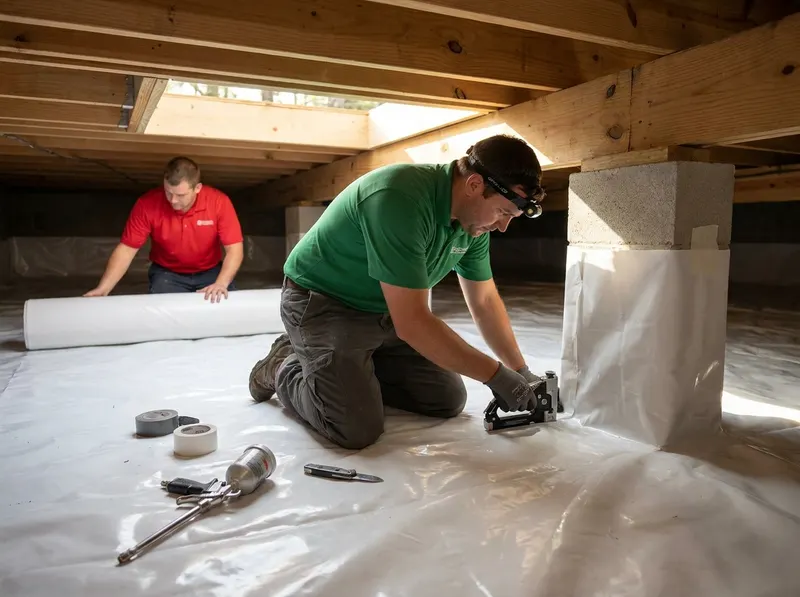
Crawl space encapsulation and vapor management addresses the primary driver of wood-destroying organism activity across Nash County: relative humidity exceeding 70% in unconditioned crawl spaces. In neighborhoods along the Stony Creek Reservoir and low-lying ground near Sandy Cross and Oak Level, clay-dense soils hold persistent runoff. Warm outdoor air entering traditional foundation vents meets cooler subfloors, causing condensation that dampens floor joists and provides an ideal habitat for subterranean termites, powderpost beetles, and camel crickets. Encapsulation resolves this by separating the structure from native soil humidity rather than relying solely on repeated chemical insecticide sprays.
A complete system utilizes a continuous 12-mil to 20-mil reinforced polyethylene barrier across 100% of the exposed crawl space floor, run 6 to 12 inches up foundation walls and interior support piers. Every seam is permanently sealed with structural acrylic seam tape. The North Carolina Residential Code requires leaving a continuous 3-inch unobstructed inspection gap below the wooden sill plate so termite entry tubes remain instantly detectable. In properties situated throughout Birchwood, Forest Hills, and Westwood, technicians also install insulated vent covers to halt external airflow, pairing the sealed barrier with a commercial crawl space dehumidifier calibrated to sustain relative humidity below 55%.
Selecting encapsulation involves distinct trade-offs compared to loose-laid 6-mil dirt covers. A thin plastic sheet laid over un-cleared soil reduces evaporation temporarily, but punctures easily during maintenance and leaves wall masonry exposed to capillary moisture transfer. Full encapsulation requires a larger upfront investment and ongoing mechanical maintenance for drainage pumps or dehumidifiers, but stops fungal spore dispersion into upstairs living spaces and removes the microclimate required by wood-boring insects. Technicians confirm scope and dimensions during an initial on-site evaluation, with pricing transparently tied to square footage, access clearances, and debris extraction needs.
Every job gets a firm, written price after a free on-site visit.
Tell us about your crawl space encapsulation and vapor management job in Nashville and we'll send a clear, written quote, usually the same day.
 Calvirox Pest Control