Bed bug heat and chemical eradication targets bed bug biology across all life stages, including egg, nymph, and adult. Thermal remediation heats the ambient air within an enclosed space to between 122 and 135 degrees…
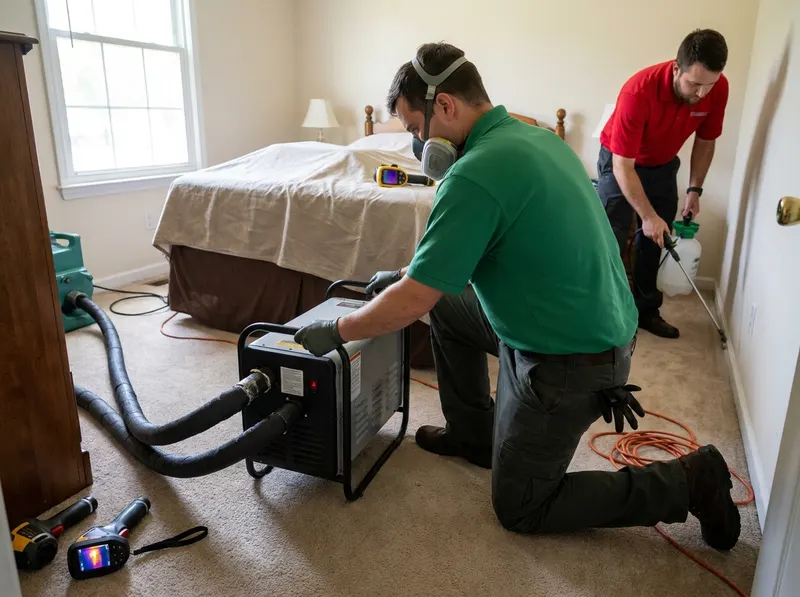
Bed bug heat and chemical eradication targets bed bug biology across all life stages, including egg, nymph, and adult. Thermal remediation heats the ambient air within an enclosed space to between 122 and 135 degrees Fahrenheit, penetrating wall voids, mattresses, and interior trim where standard contact sprays fail to reach. Chemical applications deploy non-repellent residual formulations along structural baseboards, electrical outlet plates, and door frames to stop secondary migrations. Choosing whole-structure thermal remediation suits severe multi-room activity in larger homes along Western Avenue or near Birchwood, whereas targeted dual-treatment protocols provide sufficient coverage for contained single-room activity in compact single-family residences in Westwood and Forest Hills. The trade-off centers on upfront equipment staging time versus treatment longevity; thermal work requires thorough pre-treatment preparation by the occupant, while chemical residuals remain active for up to 90 days post-application.
Older construction near the Nash County Courthouse and rural residences bordering Stony Creek or Castalia Springs often feature subfloors and older trim profiles that demand precise barrier containment. Standard hardware store contact sprays consistently scatter bed bugs deeper into interior wall assemblies, which expands an isolated bedroom issue into adjoining living spaces. Professional remediation seals these migration avenues using targeted dust formulations inside electrical fixtures alongside liquid residuals on structural perimeters. Treatments avoid compulsory annual renewal agreements, functioning as standalone barrier remediations that restore sanitary indoor hygiene.
1. Technicians conduct an initial physical assessment, inspecting box springs, mattress seams, baseboards, and window casings to measure the infestation footprint.
2. Inhabitants complete a targeted prep list, removing pressurized canisters, heat-sensitive electronics, cosmetics, and domestic pets from the target zone.
3. Technicians position high-output industrial heaters and directional air movers to sustain 122 to 135 degrees Fahrenheit across all room surfaces for a minimum of 4 hours.
4. Specialists apply EPA-registered residual chemical barriers to structural perimeters and sub-surface junctions once temperatures normalize.
5. Occupants return after a four-hour chemical drying window to resume normal living activities without persistent fumes.
Every job gets a firm, written price after a free on-site visit.
Tell us about your bed bug heat and chemical eradication job in Nashville and we'll send a clear, written quote, usually the same day.
 Calvirox Pest Control